Fears for Oxford Street ‘public space’
Residents groups say they have serious concerns about mayor’s plans to ban vehicles
Tuesday, 24th February — By Tom Foot
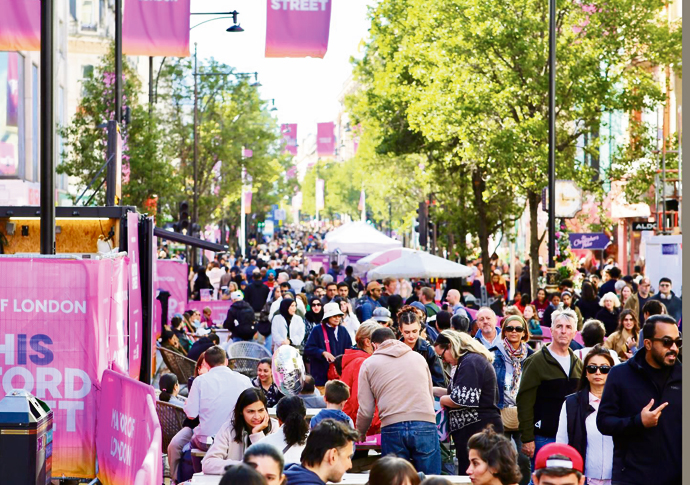
September’s car-free test day, Oxford Street [Mayor of London]
A COALITION representing several residents groups in the West End say they fear that the Mayor of London is transforming Oxford Street into a cash cow.
The West End Community Network (WECN) say they have serious and growing concerns about Sir Sadiq Khan’s plans to ban vehicles from using the main high street between Oxford Circus and Selfridges.
Planning and licensing powers for the area have been taken away from the city council through a new mayoral development corporation (MDC). This followed two years of negotiations between the council and resident groups about a “widely agreed” alternative scheme that has been abandoned.
In a letter to the corporation mapping out a range of key concerns about the mayor’s version of the project, WECN chair David Bieda said: “Residents are also concerned about the potential further commercialisation of the public realm within the MDC area. There is anxiety that space currently available for free and open public use may increasingly be subject to commercial hire, franchising or event use, beyond what already exists. Residents would welcome explicit reassurance that the MDC does not intend to expand the rentalisation of public space, and that clear safeguards will be put in place to protect the public realm as genuinely public.
“Absent such clarity, there is a perception that commercial imperatives may be displacing civic ones. These concerns are reinforced by recent experience.”
The letter points to the trial day in September when the section of Oxford Street was closed to traffic but the majority of the road was rented out to stalls and big-money corporations. It said:
“During the trial closure of the western section of Oxford Street last year, pedestrian benefit was limited, with pedestrian movement largely confined to existing footways. Much of the carriageway was instead allocated to commercial uses for the day. This has raised legitimate questions about whether the primary objective of such interventions is to improve pedestrian experience or to create additional commercial income streams from public space.”
The letter makes several other arguments against the MDC project, including warning that substantial numbers of buses and traffic will be “displaced” into residential areas.
The objection letter stresses that West End residents “are not opposed to change, investment or improvement”, adding: “They are opposed to a model that removes local control, displaces significant impacts into residential neighbourhoods, reduces accessibility, risks further commercialisation of public space, and excludes sections of the community from full participation in the life of the West End.”
The WECN represents Bloomsbury Association; Covent Garden Community Association; Charlotte Street Association; Fitzrovia Neighbourhood Association; Leicester Square Association; Marylebone Association; Mayfair Residents Group; Residents’ Society of Mayfair & St James’s; Soho Society; and Seven Dials Trust.
During the consultation London Assembly members put questions to the mayor about how the MDC would sustain itself financially.
Sir Sadiq responded that given the nature of the Oxford Street area, it “…would be able to leverage outside investment and commercial revenue streams”.
A fortnight ago he told an assembly committee the plan was unlikely to be fully completed this year as had been proposed. He added: “I would hope to see, subject to consultation, it becoming car-free [in the western section] this year, even if it’s interim.
“What people will see this year won’t be the finished article, but it will hopefully lead to pedestrianisation in that part of the road.”
The Oxford Street Development Corporation board is next meeting on February 27.
