General Strike flashpoint
George Binette recounts a little-known history of the how the drama of the General Strike of 1926 played out in St Pancras
Thursday, 16th April — By George Binette
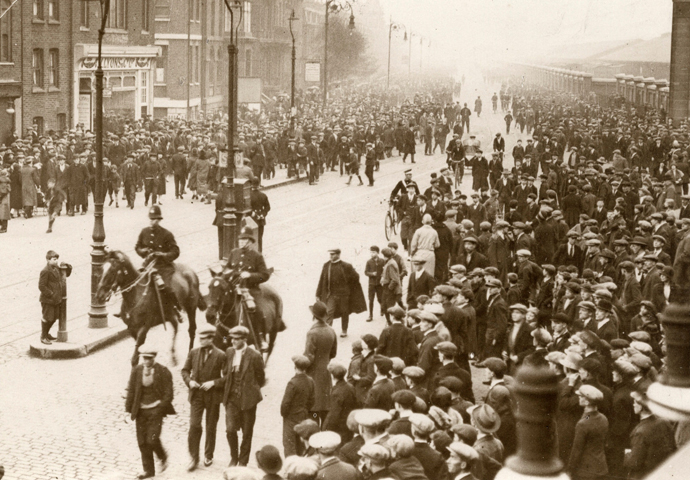
Thousands of people on the street during the 9-day General Strike of May 1926 [Wikimedia Commons]
NEXT month marks the centenary of the sole General Strike in British history. And to commemorate the strike, which began on May 4 1926 after the Trades Union Congress called for the withdrawal of labour nationwide in key economic sectors, Camden Trades Council has organised a series of events.
Some two million workers across transport, electricity, gas, the docks, heavy chemical production, building and printing walked out in solidarity with miners, who were already resisting drastic wage cuts imposed by the coal owners.
The industry’s bosses had locked out 1.2 million men, with Conservative government backing.
Camden Trades Council secretary Sarah Friday has delved deep into the archives and uncovered an incredible, previously hidden history of the General Strike in St Pancras, which proved a strike epicentre in the capital.
The local strike headquarters was at 67 Camden Road, then home to the South West St Pancras Constituency Labour Party and the then Trades Council. The Camden Road office served as distribution point for a daily strike bulletin.
Peter Zinkin, assistant secretary of South West St Pancras Labour Party and a union activist, described the scene around 67 Camden Road:
“There was a great deal of activity at the St Pancras Trades Council headquarters with a constant toing and froing of people involved in co-ordinating strike activity and keeping in touch with the situation at the rail depots and other workplaces. Some came to collect the bulletin for distribution.”
On the strike’s second day, the bulletin’s editors reported remarkable sales, with demand outstripping supply as striking printers had shut down the national press. There were “queues of eager distributors”.
Centres of militancy saw trades councils form “Councils of Action” for the strike’s duration and St Pancras was no exception. Strike committee reps reported to the Council of Action, which met daily at 67 Camden Road in almost permanent session. With three major rail termini, the borough had exceptional strategic importance.
The St Pancras bulletins featured rail union reports. The National Union of Railwaymen (NUR) branch at Euston solidly backed the strike and recruited 200 new members. NUR Camden No3 (Underground branch) exuded confidence on May 7, “Our position is splendid, our men as firm as a rock. We are assured that there can only be one end to the fight. Adopt the slogan – stand firm to win.”
The borough witnessed multiple clashes between strikers, their supporters and the police, who sought to clear the streets for buses and trams driven largely by volunteer strike-breakers, often recruited from the universities and including fascist elements.
On May 10, 2026, police conducted a midnight raid at 67 Camden Road, seizing some headed Trades Council paper, typewriters and a Roneo duplicator machine, and arresting Jack Smith, the Trades Council’s 21-year-old secretary.
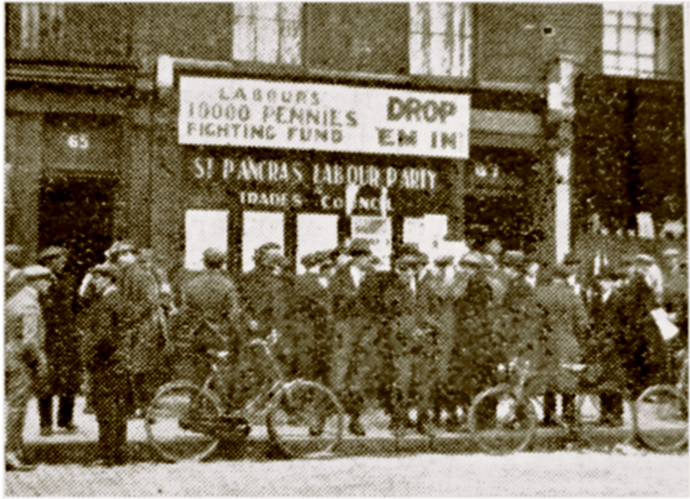
St Pancras Trades Council delegates outside 67 Camden Road, Camden Town
Smith stood accused of issuing seditious material in a St Pancras strike bulletin, relating to an incident in Harmood Street, where: “The police attempted to draw about the buses, and formed a cordon in Harwood (sic) Street, of course a crowd collected, a covered lorry then drove out of the garage and run up and down Harmood Street, and someone inside the lorry proceeded to fire blank shots, obviously intending to stampede the crowd. There was some disorder, but fortunately our men controlled the situation and no one was hurt.”
The St Pancras Council of Action established a Women’s Group for St Pancras. The work included organisation of women workers and special relief work among other activities. It met daily at the Old Turkish Baths, Kentish Town Road.
St Pancras Bulletin of May 7 reported some un-unionised women were still working. The bulletin hoped that they would realise that their interests as poorly paid workers were identical to the miners. A women’s committee emerged to rally the district’s women. When the TUC called off the General Strike, leaving the miners to fight in isolation, it was the women’s committee that continued to organise much of the support.
A mass meeting took place on May 9 at Bedford Palace Music Hall, 93-95 Camden High Street, for trade unionists and their wives. The hall couldn’t accommodate the “great gathering,” so an even larger meeting took place outside. Speakers included Jimmy H Thomas, general secretary of the NUR, who “received a tremendous ovation”. (Days later Thomas would be denounced for his betrayal of the strike.)
The notification suspending the strike came on May 12 at 1pm, without “any firm agreement”, no concessions to the miners, and no arrangements for an organised return to work with guarantees against victimisation of strikers.
Peter Zinkin wrote that on Thursday, May 13, the numbers striking in St Pancras were higher than the previous day. As a result, employers dropped many threats of victimisation, although attempts to continue the strike in defiance of the TUC’s decision failed.
On May 13, thousands of St Pancras workers attended a hurriedly convened meeting at Cumberland Market, near the Albany Street army barracks. Miners’ leader AJ Cook spoke, along with other national speakers and local Labour activists. There were harsh words for Tory prime minister Stanley Baldwin, Labour leader Ramsey MacDonald and NUR General Secretary Jimmy Thomas.
In an article entitled “Ten days that shook Britain”, published after the strike’s end, the Trades Council proclaimed that the filter of darkness that had descended from May 12 was finally lifting, when the victory that solidarity had ensured them had ended in the most abject defeat – but that “this is only the first skirmish. The fight is yet to come”.
• A talk about St Pancras during the General Strike by Camden Trades Council Secretary Sarah Friday will take place on Monday April 20, from 6pm, at Hamilton House, the National Education Union HQ in Mabledon Place, WC1H 9BD
• To mark the 100th anniversary of the start of the general strike Camden Trades Council will unveil a red plaque at 67 Camden Road, NW1 9EU – headquarters of St Pancras Trades Council – on Monday May 4, 10.30-11am
• An exhibition of St Pancras Trades Council strike bulletins and photos will be on display in the Upstairs Function Room, Cock Tavern, 23 Phoenix Road, Somers Town, NW1 1HB, from April 26-May 31.
Email: camdentradescouncil@gmail.com
