Street’s ‘too narrow for wheelchairs’
Celebrity campaigner checks out the bollards on the ‘new’ Oxford Street
Friday, 30th October — By Caitlin Maskell
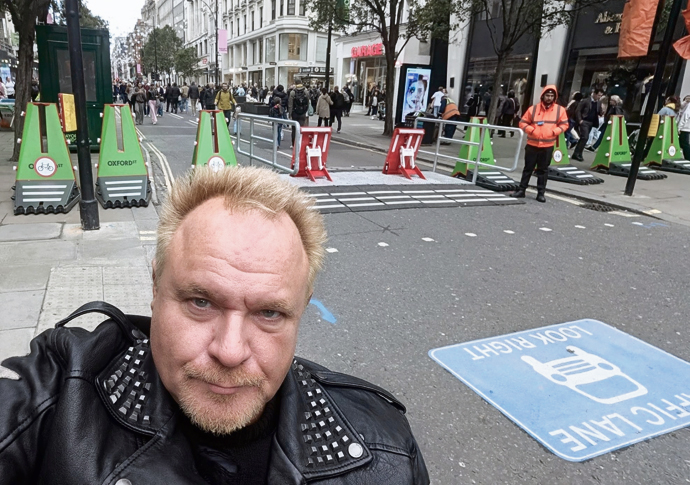
Mik Scarlet in Oxford Street on Monday
A DISABLED campaigner has slammed the newly pedestrianised Oxford Street, warning that anti-terror measures mean it is impossible for wheelchair users to access the street.
Former TV presenter Mik Scarlet went to test out the stretch of Oxford Street from Oxford Circus to Selfridges on Monday, the first day of pedestrianisation.
The space between bollards blocking the road and pavement are too narrow for his chair to get through. He told Extra: “They’ve got all these bollards that are just all over the place.
They have been placed willy-nilly, some are really close, some are a bit wider apart, some you can get through, some you can’t. And the problem with that is if you’ve got a wheelchair user that is wide, as wide as the gap they’ve left and you’re trying to vie through a space with people rushing about, it doesn’t work.”
Buses have been rerouted as part of the first phase of the transformation of the world famous shopping street in a project more than a decade in the making.
Anti-terror bollards are heavy-duty, crash-tested, steel or reinforced concrete posts that are designed to stop high-speed or heavy vehicles from ramming into crowded public spaces.
There is a legal requirement to have a maximum gap of 1.2 metres to block vehicles but also allow wheelchair users and pedestrians to pass through.
Mr Scarlet (inset), who was born with a rare form of cancer and became a wheelchair user aged 15 following multiple surgeries, is the co-chief executive of the PHAB charity that brings together disabled and non-disabled people through clubs and activities. He said: “What’s happening is that these very obvious mistakes that are being made in the name of safety, due to terrorism, are becoming just the way it’s done. At the moment this is temporary but what happens when this becomes permanent?
“I really think that as we see pedestrianisation rolled out more there needs to be an agreed standard that combines accessibility with terror prevention. Currently the attitude is that preventing terrorism trumps everything but as, Network Rail found out at Euston station, legally this isn’t the case. Prevention of terrorism has to be accessible too. For all disabled people, not just shouty ones like me.”
He added: “For decades I have been going around telling people how to do things that to me are so obvious and what’s worse is they are written in law. We’re paying the mayor to make sure the rules are followed.”
The project has been created by the Oxford Street Development Corporation (OSDC), a newly formed planning authority established by Mayor of London that removed control of the street from Westminster City Council.
Back in 2018, Sadiq, Lord Khan’s pedestrianisation plan was spiked by Conservative-run Westminster that feared an election backlash.
Labour-run Westminster Council had spent two years on an alternative project when the mayor removed their powers to make decision for the street in 2024.
Scar Barclay, co-director of DisOrdinary, promoting disabled artists, said in a statement released on Monday by the mayor that: “We have been working with the design teams to understand disabled people’s experience of the street as it is and could be through its pedestrianisation. Oxford Street pedestrianisation may provide an example to future developments of how we can modify a built environment not originally designed with disabled people in mind.”
A Transport for London spokesperson said: “All pedestrian crossings along Oxford Street will have tactile paving and accessible crossing points with dropped kerbs, while we will ensure signage is installed across the area to support people with way-finding and other important information.
“Temporary safety barriers, which are widely used across the UK for large events, have been used on Oxford Street while we install more permanent measures.
“We are aware that some visitors may have had trouble manoeuvring through these temporary measures, and we are working to replace these with more permanent measures as soon as possible.”
