‘Parks must come clean on muddy art fair’
Royal Parks charity under fire over Frieze aftermath and ‘transparency’
Tuesday, 24th February — By Finn Logue
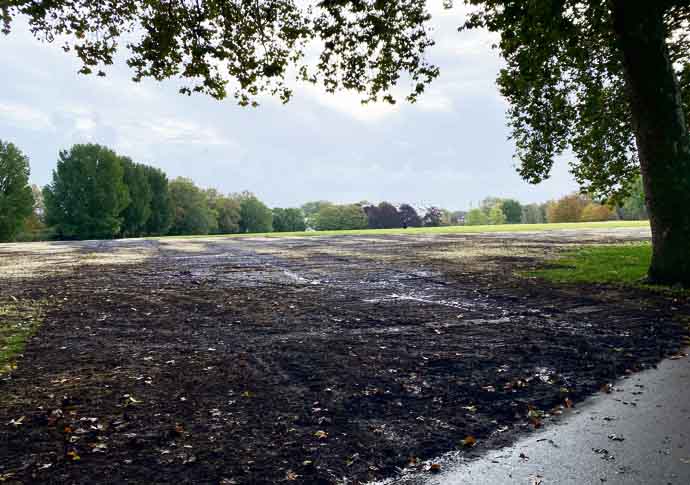
Aftermath of the Frieze art fair in The Regent’s Park
A MUDBATH created by an art fair four months ago has triggered warnings about the commercialisation of public park space.
Residents are demanding greater transparency about The Royal Parks charity’s finances and its ongoing partnership with Frieze London.
Space the size of six football pitches in Gloucester Green and Marylebone Green, The Regent’s Park, have been out of bounds for months, with works to reopen the space repeatedly delayed.
The Royal Parks say the annual Frieze provides crucial funding allowing it to offer other facilities and events to the public. But actor Annabel Leventon, who has lived near the park for 40 years, said: “It’s a big field that gets used for commercial art selling and then it churns up the mud and blights the whole area. It’s just an exercise in commercial usage. Our parks have become really, really vital over the last few years, especially since Covid. They are safe green spaces where people can relax, and I think they need protecting.”
Ms Leventon said she understood the parks needed funding but questioned whose interest the current system was in. She said government funding could help local councils help ensure that use of The Royal Parks remains in the public interest.
The Royal Parks – with eight parks in London including Regent’s and Hyde Park – says it raises around 85 per cent of its total annual costs, reportedly £75million, from commercial and sporting events and charity donations. The remaining 15 per cent came from the government.
Despite being owned by the Crown, the monarch does not fund the parks that are run by the charity.
Vanessa Fernquest, whose four children train in Gloucester Green for the football team United Dragons, said the environmental impact of the festival was “in contrast to the spirit of the park itself”, and added: “There needs to be more transparency on the park’s funding, and how the funding is used. We understand that the Frieze festival generates a lot of income for the park which helps maintain the football pitches long-term, which we appreciate. But the festival itself has a crazy carbon footprint, every year the grass gets ruined like clockwork and it is just such a disturbance to the park and people who use it.”
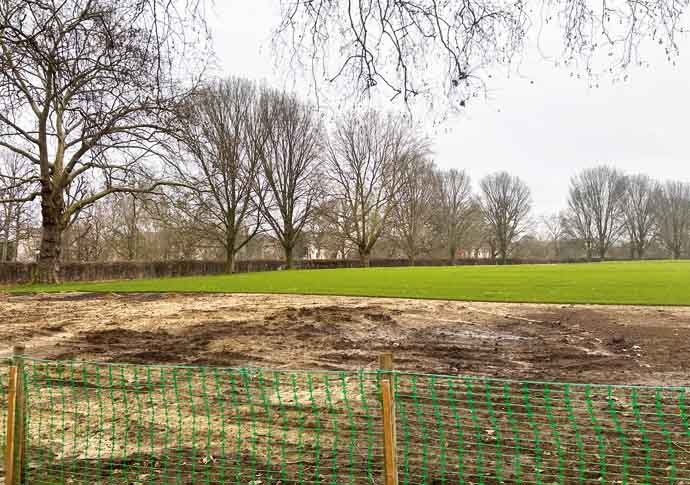
A ‘sorry for any inconvenience’ sign has gone up
There are no publicly accessible records for how much Frieze pays to the Royal Parks to use the public spaces.
In September the Royal Parks charity put a sign up outside Gloucester Green informing residents that the section of the park would be out of use until November. The sign was replaced months later with one saying January, and then again a new one saying it will not reopen until the end of March.
Joel Hopkins, who lives nearby, said that the “disingenuous” signs that go up at different times was a recurring trend over the last few years of the festival, keeping park-users in the dark. He said: “When the festival puts an area the size of six football pitches out of use for six months, it makes us question whether the money raised is actually doing the job it is intended to do. If the park was upfront with us in September, and admitted the field would be unusable until March, people would at least have the full picture presented to them. It feels sneaky to keep changing the dates on the signs when they know full well it won’t be back until late March at the earliest.”
In response, a spokesperson for the Royal Parks said: “We work closely with our event organisers to minimise disruption to park visitors and local residents. The Frieze fairs take place in two areas of the park – Gloucester Green and Marylebone Green – the rest of the park remains open throughout.
“The event is a highlight of the international art calendar, contributing to the wider London economy as well as the parks. It costs around £75million a year to manage the parks.
“Major events across the eight Royal Parks continue to be extremely popular and successful, raising vital funds for the charity. This money is invested back into the parks for all to enjoy now and in the future.”
A spokesperson for Frieze said: “Frieze works closely with The Royal Parks to protect and fully reinstate the areas of The Regent’s Park used for Frieze London and Frieze Masters, with comprehensive ground-protection measures in place and clear communication shared in advance with local residents.
“Alongside the fairs, Frieze Sculpture presents free public artworks in the park each year, and together these initiatives welcome significant international audiences to London, supporting the city’s cultural life and generating substantial economic benefit for local businesses.”
Frieze London and Frieze Masters 2025 ran from October 15 to 19, the former focusing on contemporary art, with Masters showing works made before the 2000. Combined they attract 85,000 people each year and the 2026 event is due to start on October 14.
