Coal, Corrie and Callaghan: whatever happened to the working class?
A new book about the fragmentation of the working class tells us much about the kind of society we are today, as Douglas Beattie discovered
Thursday, 29th October — By Douglas Beattie
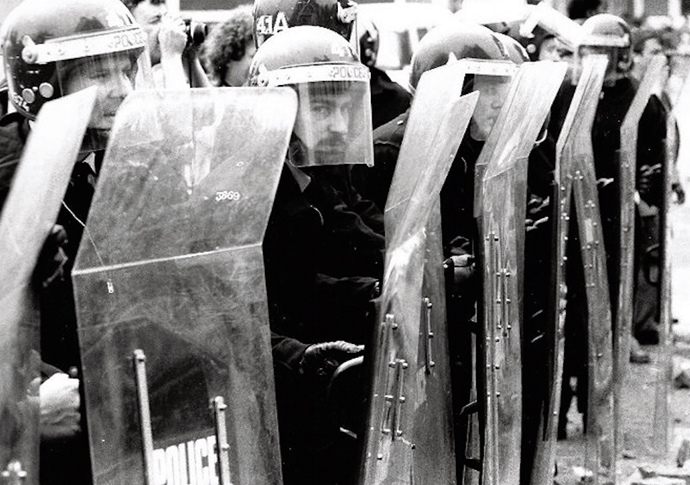
Police in riot gear at the Battle of Orgreave [West Midlands Police_CC BY-SA 2]
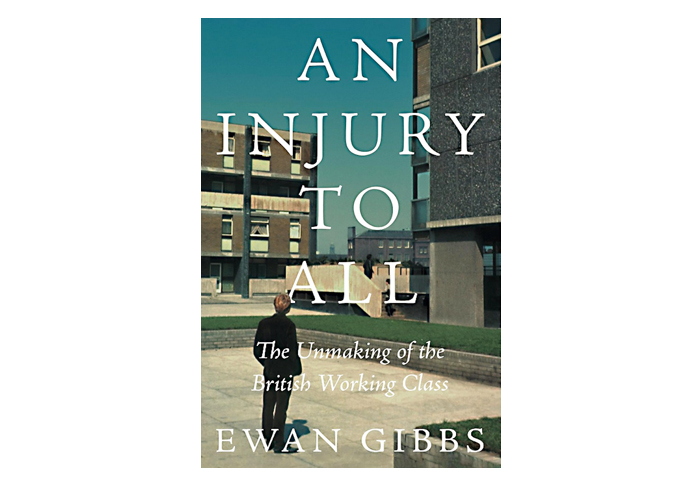
WHATEVER happened to the working class? That is the fundamental question being asked by Scottish historian Ewan Gibbs in his new book An Injury To All: The Unmaking of the British Working Class. It might equally be – how on earth did we get here, socially, economically and politically?
The picture revealed, on almost every page in a sweep of history from 1945, is that so much has been lost and forcibly removed. This boils down not only to the erosion of industry and jobs but the accompanying shared experiences, communal ties and wider consciousness which gave meaning to so many lives.
Crackling with oral history what emerges is a clear-sighted and searing portrait of a country ill at ease while undergoing transition from the core industries of the 20th century to the gig economy and Amazon warehouses of today.
There is a mini portrait of Jimmy Hood, a Lanarkshire coal miner who went south to Nottinghamshire, joining a thriving community of miners from across the UK, Europe and parts of what was once the British Empire. Having taken part in successful walkouts in the early 1970s Hood then supports the national strike of 1984-85, unlike many pitmen in that county.
Eventually he would go back to Scotland and become a Labour MP. His seat was lost in 2015 on the rising tide of Scottish nationalism which, as Gibbs puts it, saw “a Labour Party yoked to the British state and the concerns of an increasingly divergent English electorate”.
The book takes the reader on journeys through the building of modern post-war Britain. Here we find nationalised industries, full employment and a growing consumerism before moving into a changing landscape in which coal is supplanted by oil as the country’s leading source of fuel

Jayaben Desai who led the dispute at Grunwicks
In all of this the working classes are to the fore, with mainstream culture reflecting their prominence back at them through the likes of Coronation Street and Morecambe and Wise, shows which regularly commanded television audiences in the tens of millions.
Unsurprisingly Gibbs also offers detailed and lively explanations of workplace mobilisations in which workers are pitted against bosses and government alike, often in search of satisfactory wages and better conditions.
There is a thorough investigation of the landmark Grunwick dispute. Dubbed “strikers in saris”, this saw mainly female Asian immigrant workers battling for decent pay and trade union recognition at a north London photo processing factory. It was a dispute which, over two years from 1976, commanded headlines and widespread support.
However, as Gibbs points out, “policing at Grunwick was distressing and violent”. It had a political element, namely “to undermine the legitimacy of the strike by closely associating picketing with criminality”. This took place under James Callaghan’s Labour government and, according to the author, was a harbinger of the tactics unleashed on striking miners in the 1980s.
In examining coal Gibbs focuses on the closure of Cardowan Colliery in Lanarkshire, back in 1983. Here he identifies a crucial change in approach with management making financial inducements to divide the workforce – “a taste of things to come in Britain’s coal industry but also across the wider economy”, he writes.
One of the many strengths of the book is that though the author is an academic his writing has a lightness of touch, producing a narrative which gives life and meaning to the many stories produced on the page.
He also delves into other defining issues, including the “right to buy” discounts for millions of council housing tenants from the 1980s and the impact of New Labour, all the way to the general election of 2024 and Keir Starmer’s own attempts to deal with the question of class.
Gibbs’ argument is that the unmaking of the working class was not something which simply happened as a by-product of the huge forces of deindustrialisation and globalisation.
Rather, it was a deliberate act, undertaken by politicians and industry alike. The fraying of class solidarity, and the erosion of trade union strength, among many other factors, depoliticised and suppressed the collective strength of British working people.
This is a book which deserves its place alongside the likes of Eric Hobsbawm’s The Forward March of Labour Halted? and EP Thompson’s The Making of the English Working Class, from which it draws its title.
It belongs in such company precisely because it seeks to address the issues which shape the society and politics we swim in today.
The destructive “unmaking” that Gibbs speaks of has taken place across several decades and as he rightly suggests there is an urgent need to rectify this if we are to prosper and heal the many ills we face in the here and now.
• Douglas Beattie is the author of Victory at the Ballot Box: The History of How Labour Built Britain
• An Injury to All: The Unmaking of the British Working Class. By Ewan Gibbs. Verso Books, £25
