‘Detestable as women’: feminist writer who had sharp words for the Pankhursts
In the latest in his series on eminent Victorians, Neil Titley considers the novelist and queen of tact, Gertrude Atherton
Thursday, 19th February — By Neil Titley
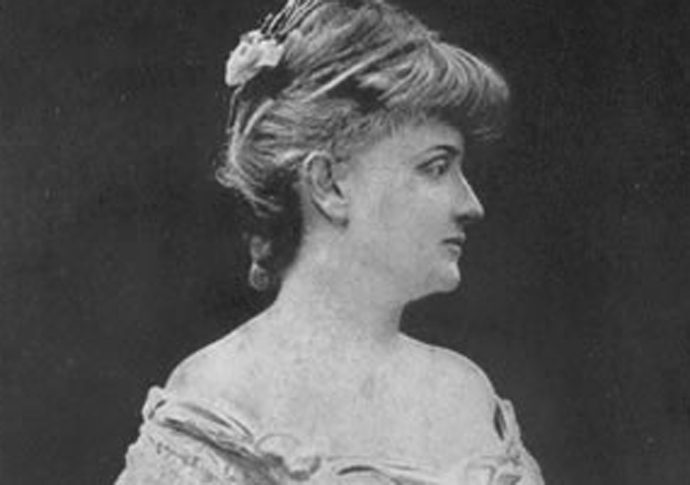
Gertrude Atherton [Project Gutenberg]
WHILE Mrs Emmeline Pankhurst’s statue in Victoria Gardens has been a beacon for the Suffragette movement since its erection in 1930, not all feminists have regarded her favourably.
The American writer Gertrude Atherton (1857-1948), while a doughty upholder of women’s rights, thought the Pankhursts were “detestable as women” but successful as “scientific martyrs”.
This followed a meeting during which Gertrude reported that: “Mrs Pankhurst fixed me with a glacial eye and permitted me to understand that she had no use for mere novelists who gave little evidence of being eager to die for the cause.”
Born Gertrude Horn in San Francisco, Atherton was educated in California and Kentucky where she admitted that she had spent “an insurgent and heedless youth”.
When she married, this was a description with which her husband George Atherton might well have agreed.
George endured a stormy courtship during which Gertrude, irritated by his attentions, had trained her dog to attack him. After five proposals, Gertrude reluctantly consented to the wedding, mostly to get some peace “but I preferred Plato!”
The marriage was in trouble from the outset given their lack of mutual interests. Gertrude adored literature while George struggled to read even a penny shocker. Gertrude once said: “He still hadn’t finished it when he died nine years later.”
Despite the birth of two children, Gertrude became bored by the monotony of marriage and flirted outrageously with other men. As she explained: “I accumulated four devoted admirers and, taking a firm stand with my husband, permitted them to call in the afternoon and evening. Whenever they were there, George stalked up and down the hall looking coal-black or hung over the banisters muttering.”
She poured her energies into writing and continued to ignore her husband. “I locked the door against George at night, no matter how much he pounded on it.”
She justified one flirtation by telling him: “He’s worth two of you for he is somebody and you are nobody. If you have any pride, you would make something of yourself.”
Finally goaded beyond endurance, George took her at her word and left to carve a fortune in Chile. Unfortunately, he died on the voyage out.
Even in death he was unlucky as, given the tropical heat, his body had to be embalmed in a barrel of rum. The sailors, angry over the contamination of their liquor ration, refused on superstitious grounds to travel with a corpse. It finally had to be smuggled on board and brought home camouflaged under a pile of coconuts. Gertrude later recalled: “It was years before I could even look at coconuts again.”
In 1882 she published her first book, The Randolphs of Redwoods.
Leaving her surviving child Muriel behind with her husband’s family, Atherton left California to begin a life of international travel and to acquire the experiences that gave her the material for over 40 novels.
While in London, she stayed with the Spectator writer William Sharp and his wife at 17A, Goldhurst Terrace, South Hampstead, and mingled with the likes of Oscar Wilde’s mother, and a youthful, slightly smitten Winston Churchill.
She observed that “Englishmen are sentimental and romantic under their impassive exteriors”.
Meanwhile, some of her contacts with American literati lacked decorum. Having survived attempted rape by Ambrose Bierce, she was apprehensive about encountering Walt Whitman. “I had been told I would have to kiss him, but he was very hairy and averse to soap and water. A friend had written me that she had searched in vain for a clean spot before performing the rite.”
A week before the arranged meeting Atherton was greatly relieved to pick up a newspaper “and read that Whitman had gone to his eternal rest.”
As for Bierce, she maintained a barbed but invigorating lifelong friendship with her would-be ravisher.
Despite her total inexperience as an orator, in 1912 she was persuaded to give political speeches on behalf of the Democrats and surprisingly her efforts were said to have aided Woodrow Wilson to the White House. Her lack of interest in politics and her habit of evading Republican queries by briskly declaring: “Oh, that doesn’t matter. Nothing matters much, you know”, charmed the voters of California.
Later she moved sharply to the right, becoming a bitter opponent of communism, and a supporter of white supremacy as embodied in the Nordic ideal.
Before the entry of the USA into the First World War in 1917, Atherton went to France to inquire into the harrowing conditions of the French military hospitals.
Shocked by her investigations, she worked hard to raise charity money back in America. She found that she enjoyed the role of reformer – “nothing inflates the ego more”.
In recognition of these efforts the French government offered her a medal. With her characteristic lack of tact, Atherton replied in a statement that caused a predictable quarrel: “You know, there is only one way left in this world to be distinguished and that is not to be decorated by France”.
• Adapted from Neil Titley’s book The Oscar Wilde World of Gossip. See www.wildetheatre.co.uk – available at Daunts, South End Green
