Home truths: ‘If we want a better future, we have to push for it’
Angela Cobbinah finds a new book that aims to explain and offer a solution to London’s housing problems both enlightening and chilling
Friday, 13th February — By Angela Cobbinah
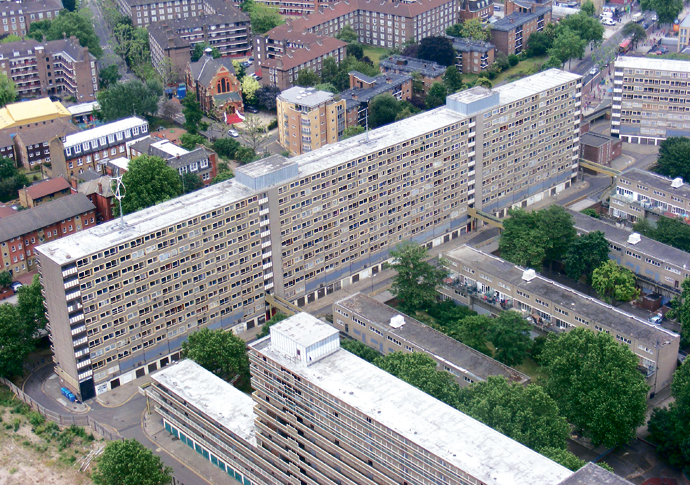
The former Heygate estate, in Elephant and Castle. The plan for its transformation in 2014 into 2,700 new homes included only 82 for social rent
IT was the focus of a bitter planning battle waged by residents over a lucrative slice of real estate on the edge of Clerkenwell that mayor Boris Johnson weighed into and personally signed off. More than a decade on, the controversial 700-home development in Mount Pleasant has just reached completion, a series of lacklustre, tightly packed blocks rising incongruously above the neat Victorian streetscape that characterises this part of London.
Occupying part of Royal Mail’s sorting office site and touted as a “new London neighbourhood”, it is one of the many instances of how public land is being flogged off to property developers in the midst of London’s housing crisis. With only 70 homes for social rent and flats selling for more than £1 million, far from easing the problem, schemes like this only make it worse, says Peter Apps in his latest book, Homesick.
It follows Show Me The Bodies: How We Let Grenfell Happen, his excoriating account of the consequences of treating social housing tenants like second-class citizens. This time, he places his forensic lens on London as a whole, examining how 40 years of housing policy has led to ever spiralling rents and property prices, which threaten not only the future of those struggling to get a secure roof over their head but that of the capital itself as people are forced to move out and find somewhere they can afford to live.
“It is a story of the consequences of confusing economic growth with progress,” writes Apps, deputy editor of industry magazine, Inside Housing. “It is a story of a city where the value that can be extracted from its buildings has taken precedence over the humans who live inside them. It is a story of a city which is no longer fit for purpose.”
The rot, he says, began in 1980 with Right to Buy whereby council tenants – then 35 per cent of London’s population – could buy their properties at a generous discount as part of Margaret Thatcher’s drive to turn Britain into what she called a property-owning democracy.
The problem was, she barred local authorities from replacing lost housing. This led to a drastic shortage of council homes and people scrambling to get on to the property ladder.
As demand saw house prices rise and rise, Thatcher and subsequent governments launched a range of subsidised mortgage packages to keep it that way. With social housing now in managed decline, this included Buy to Let aimed at encouraging private landlords to meet housing needs, with the abolition of rent controls thrown in.
Returning to the East End street he grew up in to view a rental property as part of his research, Apps is shown a room in which the double bed takes up most of the floorspace and black mould is visible beneath a fresh coat of paint. Cost: £1,000 a month plus a warning that late payment will incur a fine.
The house was a “pokey” Victorian terrace in Canning Town built for dockworkers, identical to the one his parents bought for £26,000 in 1987, he tells us. Today, in place of a settled working-class neighbourhood, is a transient community living in homes owned by landlords and being squeezed for well over half of their salaries to get a dingy room.
“This is no accident,” he explains. “We have deliberately changed the primary purpose of houses from providing a home for a family to providing an income-generating asset for investors.”
Disinclined to build housing itself, government has turned to private house builders to take the strain. Nowadays, London’s skyline is littered with expensive apartment blocks inspired by the pack-’em-in school of architecture, many dominating so-called council estate regeneration schemes like Heygate in Elephant and Castle, whose transformation into 2,700 new homes in 2014 included only 82 for social rent.
To make matters worse, as housing associations jump onto the property development bandwagon, we learn that waiting in the wings to take over their social housing stock are companies like Sage, a for-profit housing provider backed by controversial US private equity outfit Blackstone.
Well written, informative but unavoidably unsettling, Homesick weaves in the stories of those caught up in the stitch up. There’s Andy, one of a group of residents who are fighting to stop Lambeth Council demolishing the Cressingham Gardens estate overlooking Brockwell Park in partnership with a private developer, and Carolyn, a retired civil servant who was evicted after her landlord almost doubled her rent but told by Lewisham Council that it could only rehouse her in County Durham. There are winners,too, notably those who bought property in the early days of the boom, but the irony is, home ownership has not increased since its peak in 1991, reports Apps.
Recent years have seen a renewed commitment to good quality social housing by councils burdened by the costs of placing homeless families in temporary accommodation.
However, nowhere near enough is being built to slow the exodus from London of young people who find themselves priced out of the market, leaving school closures and other manifestations of fractured communities in their wake.
So what is to be done? Apps looks at enlightened models of housing provision in cities like Vienna, Barcelona and Brussels in which social well-being is the chief focus, tentatively suggesting that what has been lost in one generation can be rebuilt by the next.
But he warns: “If we want a better future, we have to push for it.”
• Homesick: How Housing Broke London and How to Fix It. By Peter Apps, One World, £20
