The joy of text…
For many, the screen has replaced the printed word. But is it ‘the most important cultural shift of our time’? Michael Church investigates
Thursday, 15th October — By Michael Church
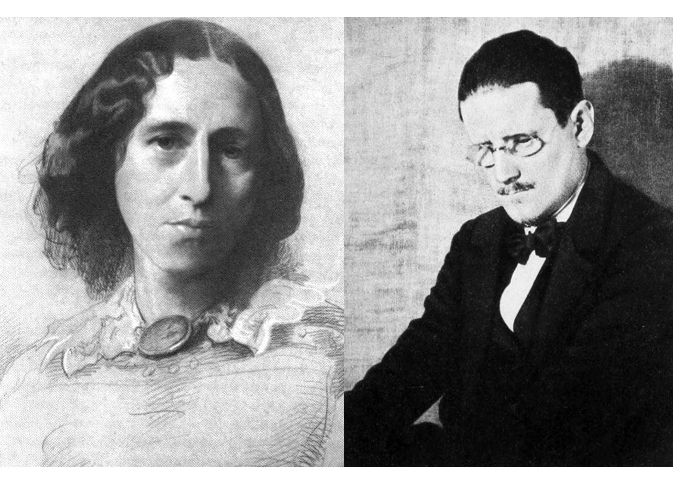
George Eliot and James Joyce – too hard for students today?
NEVER backward in coming forward, the author of this incendiary little book, The New Dark Ages, has been shouting his message from the roof-tops to anyone who will listen. And that means a lot of people: one of his recent Times columns clocked up more than a million “reads”.
His book’s subtitle expands that message: The End of Reading and the Dawn of a Post-literate Society. And the accompanying press release announces the terrain it will cover: “The decline in reading is the most important cultural shift of our time. The age of print is giving way to the age of the screen. The world we knew is passing away and nothing will ever be the same again. Welcome to the post-literate society.”
Enough? Do we need to read his book as well? The answer is that we should certainly read a lot of it, but perhaps not all of it, for reasons I will explain.
Marriott grounds his argument in the “reading revolution” of the 18th century, when newspapers suddenly turned reading and writing – hitherto the preserve of a tiny social elite – into a realm that included everybody. By the end of the 19th century almost every adult in Britain and North America could read.
And print culture in the 18th century, argues Marriott, kept pace with a growing hostility to religious superstition, and with the development of science; it helped usher in the industrial revolution, the idea of human rights, the rise of capitalism, and the advent of democracy. “But there is evidence,” says Marriott, “that this remarkable story may be coming to an end.”
That evidence comes in many forms, from the precipitous decline of the newspaper industry – 320 papers closed in Britain between 2009 and 2019 – to the ubiquity of AI as the lazy student’s approach to essay writing. Meanwhile, Marriott’s university-teacher informants are lamenting the fact that key texts like George Eliot’s Middlemarch and James Joyce’s Ulysses, once the backbone of the English curriculum, are now off the menu: not because students don’t want to read them, but because they can’t handle those books’ intellectual demands.
As a passionate bookworm, Marriott can’t resist peppering his narrative with affectionate little dips into his bookish home and provincial background in Newcastle upon Tyne, and there’s a transparent honesty in his anger. “I want to persuade you,” he thunders at his assembled readers, “that literacy matters profoundly to our civilisation. I believe much of the disorder and unreason of the 21st century is a direct consequence of the fading of the written word and the colonisation of our culture by addictive screens. As reading declines, the result, evident all around us, is the hollowing-out of our society.”
This may sound like a born-again preacher – and the middle chapters of his book are numbingly repetitious – but Marriott’s attack on those “addictive screens” is spot-on: “Watching a video is a relatively passive experience, but reading is a kind of thinking.” And he points to the anatomical differences which have been found between the two modes of acquiring information. American researchers have shown that when reading on a screen, the eye moves through a passage of writing in a zigzag style, as readers rapidly “word spot” through a text to grasp the context and dart to the conclusion at the end. Thumbing through fragments of text on a social media feed, says Marriott, “we pay less attention, we understand less, and we think less critically about what we read”.
No prizes for naming the American politicians who have now declared war on science, and medicine in particular, but Marriott also cites symptoms of what he calls the new Disenlightenment among left-wing progressives. One of these comes from a university in New Zealand, where Maori folklore (“ways of knowing”) is now accorded equal status with “Western science”. That policy, says Marriott, is a product of emotion, not rational thought.
One of the pleasures of this book lies in its frequent biographical detours to celebrate great writers and readers of the past – Montaigne, Rousseau, Doctor Johnson. And one of its useful functions lies in its long list of recommended reading; we are particularly urged to read Neil Postman’s Amusing Ourselves to Death: Public Discourse in the Age of Showbusiness.
So how worried should we be? The weakest chapter in this book is the one where Marriott rummages through contemporary writings, looking for hope at the end of the rainbow. “The sheer meaninglessness of screen culture,” he avers, “is a paradoxical reason to be optimistic.”
Oh really? If only.
• The New Dark Ages: The End of Reading and the Dawn of a Post-Literate Society. By James Marriott, The Bodley Head, £12.99
