The many lives of Agatha
The British Library’s Agatha Christie exhibition shines new light on the queen of crime. Martin Plaut investigates...
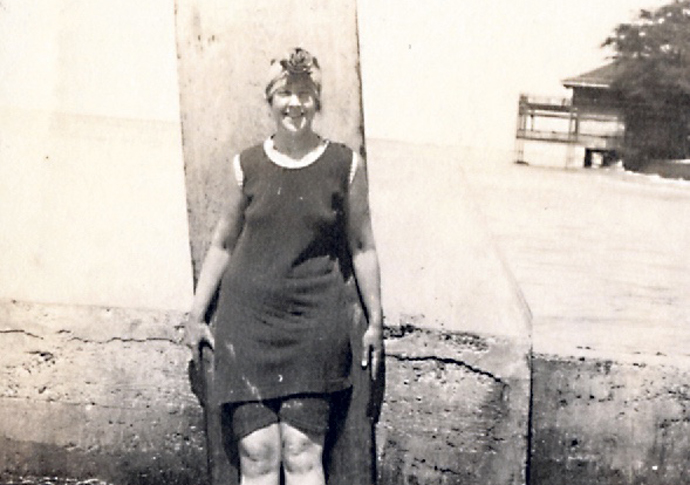
The youthful Agatha Christie in Honolulu
THE Agatha Christie exhibition at the British Library offers a rare opportunity to examine the life of the queen of crime fiction. It is hard to miss her influence on our imaginations, 50 years after her death. In fiction, film, television and the theatre she seems ever present, like a knowing Miss Marple, peering over her spectacles at us all as we rush through our busy lives.
The exhibition, which runs until June 20, 2027, is rather different from others the library has mounted. It takes us through five well-laid out, generous settings in which her life is gradually revealed, like the petals of a flower.
The first room is the “country house”: something few of us will have experienced, yet was where she spent her childhood and adolescence. It was the setting for her very first published novel, The Mysterious Affair at Styles (1920). We can see early photographs and the typescript for her first short story, House of Beauty.
Then into the “dispensary”. Here we see Christie as a volunteer in the First World War, nursing and dispensing drugs – vital for her understanding of poisons that her criminals would so frequently administer. The “Orient-Express” train carriage is next, beautifully recreated and the setting for Murder on the Orient Express, surely one of her best-known novels.
The “dig” shows Christie in Iraq and Syria in the 1930s with her second husband, the archaeologist Max Mallowan. She used the experience for Murder in Mesopotamia and They Came to Baghdad. The room has Christie’s plot notes for both novels alongside the 1937 Remington typewriter she wrote on.
Finally, there is the theatre, with The Mousetrap still drawing crowds after over 30,000 performances – the longest running play in the world after opening in 1952. There is a revealing film clip to watch, showing Christie in later life receiving an award for her contribution to the theatre. She emerges as shy and diffident, speaking rather nervously, despite her fame and public acclaim.
Lucy Rowland, lead curator of the exhibition, explains that this is the biggest exhibition held in the UK in almost 25 years. “Visitors can see over 200 items from different periods in her life, drawn from the British Library’s own collection, the Christie Archive Trust and other lenders, including material never displayed before.”
For me, the highlight is a photograph I never expected to see: Agatha Christie with a surfboard! She clearly loved her visit to Hawaii in 1922 and took to the sport. Not quite the image of the genteel lady caring for her flower beds in an apparently tranquil English village, so frequently portrayed on our screens in her murders.
However, the library did miss a trick. How was it possible to ignore the seminal period in Christie’s life when she lived in Camden? She made the Isokon Building – then called the Lawn Road Flats, in Belsize Park – her home from 1941 to 1947, at the height of the Second World War and start of the Cold War. She moved there with Mallowan after their London home was damaged during the Blitz.
They first rented Flat 22 in March 1941; Christie later moved to Flat 17 while Max was posted to the Middle East. The flats were beautifully designed, but small and the couple persuaded the owners to allow them to combine Flats 16 and 17 into a larger home.
Her six years in the Isokon were highly productive: she wrote seven novels and two radio plays.
This included the play which became The Mousetrap. Three Blind Mice – a 30-minute BBC radio play – was written for Queen Mary’s 80th birthday in 1947.
Christie certainly rubbed shoulders with Soviet spies while in the flats. Several residents and their associates were active in Soviet intelligence and the building’s shared restaurant and social spaces meant that she was certain to have encountered them.
Arnold Deutsch, an Austrian émigré and Soviet NKVD officer, lived at Isokon. He recruited and controlled Britain’s most notorious spies: the Cambridge spy ring, including Kim Philby and Guy Burgess. Jürgen Kuczynski, a German-born economist and Soviet agent, was also a resident. He recruited Klaus Fuchs, a theoretical physicist who gave nuclear secrets from the American and British Manhattan Project to the Soviet Union during and after the Second World War.
There is no suggestion that Christie knew of their nefarious activities, but MI5 did investigate her during the war. They feared she might have learned secret information about Britain’s codebreaking work at Bletchley Park. The trigger was the name of a character in her 1941 novel N or M? – Major Bletchley. She explained that the name was chosen for an entirely mundane reason. She had been stranded at Bletchley station while travelling from Oxford to London and named the irritating character after the place as a small act of revenge.
One can only wonder why the British Library ignored such a significant part of her life, in the very borough in which the library stands.
• Agatha Christie: A World of Mystery is at the British Library until June 2027. See: https://events.bl.uk/exhibitions/agathachristie
