Wilde life in the raw: Oscar's ‘poor dear brother'
In the latest in his series of eminent Victorians, Neil Titley turns his attention to Willie Wilde
Thursday, 25th June — By Neil Titley
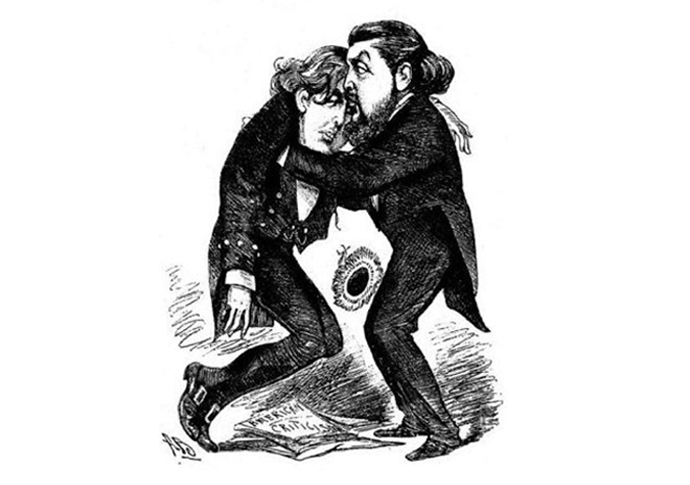
Willie Wilde – ‘Never mind, Oscar, other great men have had their dramatic failures’ A 1883 cartoon by Alfred Bryan after the failure of Oscar Wilde’s play Vera
MORE than a century after his death, Oscar Wilde’s name still regularly appears across London’s theatreland. His elder brother William Wilde (1852-1899) is less well-known.
Having, like Oscar, left Dublin for a life in London, Willie’s initial intention of following a career in law soon dissolved in drinking sprees. When asked what he was working at, he replied: “At intervals.”
Given their fraternal similarities, it was probably inevitable that the two Wilde brothers would fall out. In The Picture of Dorian Gray, one of Oscar’s characters was given the line: “I can’t help detesting my relations. I suppose it comes from the fact that none of us can stand other people having the same faults as ourselves.”
The animosity grew more intense, and Oscar was to write in An Ideal Husband: “Extraordinary thing about the lower classes in England. They are always losing their relations.”
“Yes, my lord. They are extremely fortunate in that respect.”
Willie realised the problem. He had a heavy beard and joked that Oscar paid him to wear it so that people could differentiate between them.
In October 1891, the 39-year-old Willie married Mrs Frank Leslie, a rich American aged 55. Willie was her fourth husband.
Attempting, in his words, to “create a leisure class in America”, he refused to work and instead spent his time at the Lotus Club in New York drinking cocktails. A tight-lipped Mrs Leslie paid his way for a period then stopped. Early in 1892 she deposited Willie back in London declaring: “He was of no use to me, either by day or by night”. The London newspaper placards proclaimed: “Tired of Willie!”
Footloose once more, he became a well-known figure around various London clubs, his favourite being the Pelican in Soho. The clientele of the Pelican was a mixture of millionaires and bohemians. It had an unusually boisterous reputation and some outrageous members, one of them being Lord Hugh Drummond. One night he “entered the Club and cleared its long bar counter of three dozen glasses, smashing them on the floor, and calling for a whisky and soda”. During an uproarious night, Drummond was accused of throwing a moose’s head that had knocked a peer of the realm unconscious.
He denied the charge, claiming: “I’ve not thrown anything except trifle all night.”
Another Pelican member treated his city clerk to a day at his country estate. He sent the man off for an afternoon’s shooting with a gun and a pair of retrievers. An hour later, the clerk returned and said excitedly: “I really enjoyed that. Have you got any more dogs?”
One member known as “The Shifter” was revered for his alcoholic intake, even in the Pelican. His main problem was that his redoubtable wife subjected him to lengthy tirades because he kept waking her up when he arrived home drunk every night. A friend advised him that if he just took off his boots and clothes on the stairs he could creep into bed without disturbing her. The Shifter gratefully accepted the advice.
A week later, his friend asked him how he had got on. The Shifter replied: “Well, I did exactly what you told me. I took off my boots at the bottom of the staircase. I took off all my clothes when I was half-way up. I listened as you advised me and crawled quietly to the top of the stairs. And found myself on the platform at Waterloo station”.
Owing to the amount of champagne bottles that had been hurled from its windows onto the street below, the Pelican Club became the object of frequent police raids. It was finally closed in 1892.
Meanwhile in 1894, Willie had married for a second time, on this occasion to a Dublin woman named Sophia “Lily” Lees; their child Dolly Wilde was born the following year.
When Oscar began his infamous action for libel against the Marquess of Queensberry, at first Willie was supportive. He wrote to Oscar to tell him that he was defending him “all over London”. Oscar was dubious about the value of such a defence: “My poor dear brother could compromise a steam engine!”
Oscar was right to have doubts. With an inconceivable lack of tact, Willie had announced: “Oscar does not have a bad character! In fact, you could trust him with a woman anywhere!”
During Oscar’s trials for homosexuality, Willie’s sympathy started to fade, muttering grudgingly to his brother: “At least my vices were decent.”
With Oscar’s downfall and imprisonment, Willie’s professional and social career, already insecure, was ruined due to his family connection. The name of ‘Wilde’ was now so notorious that any chance of a job vanished.
Then, tired of Willie’s drinking and abusive behaviour, Lily left him in 1896, and he sank into an alcoholic depression. In 1899 he died of hepatic liver failure and was buried in Kensal Green Cemetery.
• Adapted from Neil Titley’s book The Oscar Wilde World of Gossip. See www.wildetheatre.co.uk – available at Daunts, South End Green
