Farage damage and the rise of the far right
What was responsible for the rise of the far right, and how do we fight it? Dan Trilling, says Lucy Popescu, has unearthed a few answers... and solutions
Friday, 22nd May — By Lucy Popescu
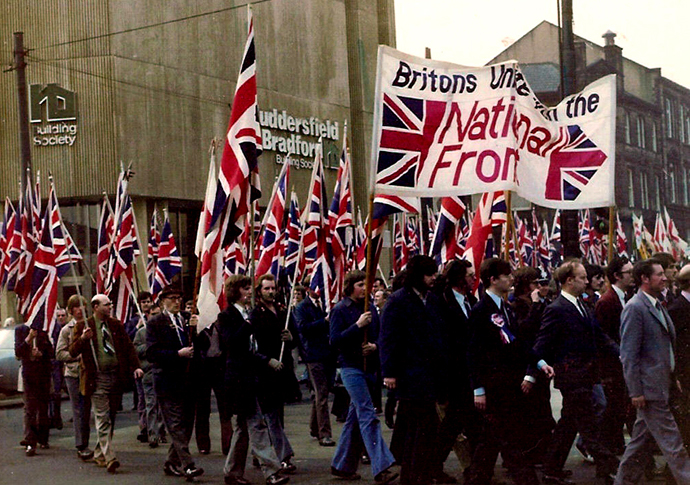
A National Front march from the 1970s [Tav Dulay]
NOW that the local election results are in, Daniel Trilling’s If We Tolerate This, a compact, incisive analysis of the rise of the far right and how to combat it, feels particularly timely.
Trilling suggests that contemporary radical right politics rely on a political style known as populism. He begins by exploring how far right populism – “for which Reform UK is our local standard bearer” – became mainstream and accepted in British politics.
He warns that Nigel Farage’s party threatens many of the rights we take for granted – including freedom from discrimination, migrant and refugee protections, and independent courts – and that if they are not challenged, we run the risk of something far worse.
Reform UK’s repeated claims, echoed in parts of the media, that we are “profoundly divided and heading for disaster unless we take the drastic action it prescribes” have helped drive the growth of right-wing populism here.
Trilling does not see this as a return of fascism: “Today’s far right has a life and momentum of its own, and must be seen as unique to our time.”
However, he maintains that the two movements share a conviction in the need to “purify your community” (Trilling’s italics), and that Reform UK’s continued attacks on “enemies of the nation” will usher in a significantly less egalitarian society.
Trilling argues that far-right politics took longer to gain a foothold in Britain because the movement here has historically been “weaker and less effective” than in western Europe.
Mainstream parties – especially the Conservatives – have helped contain the resentment that might have fuelled support for the radical right. Earlier groups such as Oswald Mosley’s British Union of Fascists in the 1930s and the National Front in the late 1960s, struggled to “tread the line between menace and respectability”. This shifted in the 2000s with Nick Griffin’s British National Party (BNP), once they toned down their racism.
The BNP’s biggest electoral gains, Trilling notes, were in places that had lost both industry and identity. After the party’s failure in the 2010 elections, it returned to the margins but something more dangerous rose in its stead. Farage and UKIP.

Daniel Trilling [Robin Christian]
According to Trilling, Farage’s great skill is staying “within the bounds of respectability… He tries to make far-right populism seem anodyne and common sense rather than the repellent set of ideas it represents.” The irony is that as a former city trader, Farage profited from both the neoliberal boom and the backlash that followed.
Austerity helped Reform UK to thrive, while “rising energy costs and food prices have given far-right populists a further boost, as voters grow frustrated with their governments.” But this has its roots in unrestrained Capitalism which, since the 1990s, Trilling believes brought greater inequality worldwide.
Neoliberalism, he reflects, aided the “shifting of power and resources away from democratic control and towards big business, particularly the financial markets”. Inevitably this feeds resentment among those who aren’t enjoying a proportion of the subsequent wealth of a few.
In the West this inequality was exacerbated by the 2008 global financial crisis. In response far-right populists, playing to the majority, scapegoat various groups of people, and promise to restore traditional, hierarchical social roles. What unites far-right populists is the contention that their nation is “under dire threat…[from] specific national enemies who can be named, blamed and punished.” So they attempt to restrict the rights of minority groups, asylum seekers and LGBT communities.
During the 2010s, austerity caused further upheavals and UKIP’s vote rose, driven by anxieties about immigration – fears stoked by the media. Yet as Trilling argues “Britain’s economy… is designed to draw on immigration to fill skills gaps and labour shortages. Immigration generally rises when the economy is growing”.
When France and Britain tightened security around Calais and the Channel Tunnel, desperate people fleeing war and poverty sought other routes across the Channel. Those who reach our shores in small boats often have family ties, historical connections, speak English or have nowhere safer to go. France and Germany, Trilling observes, receive more asylum applications than Britain.
He identifies Boris Johnson as the figure who best “exemplifies the opportunism that brought far-right politics into the mainstream”. Under his government, the Home Office used hotels at scale to house asylum seekers. Places that, Trilling notes, “are not only the targets of anger and hostility, they are demeaning and traumatising for the people housed in them”.
If We Tolerate This is a clear-eyed, accessible account of what has led to Reform UK’s unprecedented success in the local elections. But Trilling also offers solutions: a better immigration policy, for instance, would allow migrants and asylum seekers to work while awaiting the Home Office’s decisions, and help their integration.
Trilling encourages readers to inform themselves about what Reform UK are actually trying to do, to confront their racist narratives and propaganda, and to oppose their proposed weakening of democratic institutions.
He concludes: “The far right fills a vacuum: an absence of challenge to racist and divisive arguments; the holes in the social fabric left by years of failed economic policies; a sense that there’s no better option.”
There are better, more humane options, and we must fight for them.
• If We Tolerate This: How the British Establishment Made the Far Right Respectable. By Dan Trilling, Picador, £14.99
