Harrington: ‘Cartels’ make it harder to build the housing we need
Green industrialist talks about the pains of the crisis – and suggests some solutions
Friday, 17th July

Dale Vince talking to John Robb on Monday evening
THE headline reads “Can He Fix It?” and asks if the incoming prime minister, Labour’s Andy Burnham, has the political will to solve one of the biggest issues of our times: the unaffordability of housing in the UK today.
This is the splash which the latest edition of Babelfish is hoping to turn heads with – a publication steered by the green industrialist Dale Vince.
Circulated around Westminster and shoved in front of the eyes of decision-makers, it has previously dug into political funding and the demonisation of refugees.
Housing – or the lack of it – is now getting the same treatment and, at a launch event in the Strand on Monday, it was refreshing to hear a figure as prominent as Mr Vince not just talk about the pains of the crisis but suggest some solutions.
He told an audience that a massive house-building programme could kick start an economic boom and create thousands of jobs – as well as the crucial bit: offering that simple, vital element of life, a roof over one’s head.
“We have a housing crisis,” Mr Vince said frankly.
“We have people who are homeless. We have council waiting lists. We have people living with their parents for much longer than they would like.”
Working with the Centre for Economics and Business Research, Babelfish has identified brownfield sites to build the 1.4 million houses the UK needs to clear the waiting list for social housing – and that at least half of the sites already have planning permission.
Building, therefore, could start tomorrow.
“We used to hear excuses like it was hard to get permission,” said Mr Vince.
“But the fact is it isn’t hard to get planning – it is hard to get building firms to build the houses they have permission for.”
Mr Vince suggested a new law which makes developers pay tax on land they have approval to start work on – but, frustratingly, leave untouched.
We can all probably think of several sites in London where it feels like this process of “land banking” is happening before our eyes.
The idea is that if no homes are built for three years after permission is granted, the land owners would start paying as if homes were there.
“This would focus minds and provide economic incentives to halt land banking,” Mr Vince said.
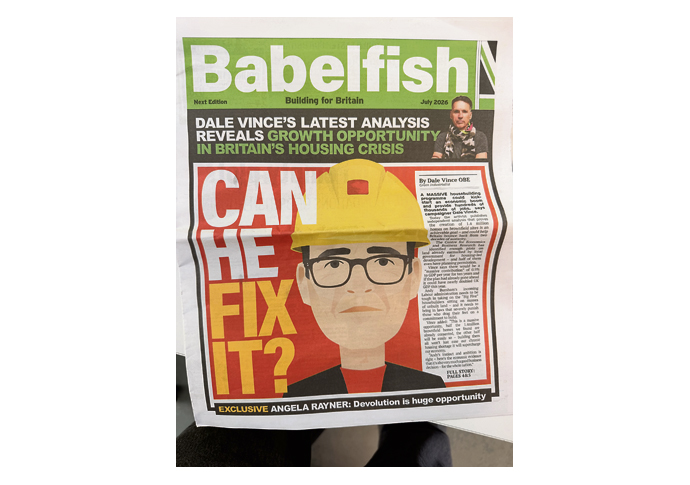
The latest edition of Babelfish
The head of Ecotricity has shown he is not willing to shy away from robust debate, and has been seen on several interviews in recent weeks warning Mr Burnham not to employ Ed Miliband as the new chancellor in the post Rachel Reeves era.
Certainly, he isn’t going to rest on the laurels of his success in green energy and a myriad of other projects.
Babelfish’s research has found the “Big Five” house builders in the UK hang onto land in a way which, lucky them!, keeps supply limited and profits high. “The building companies operate like a cartel,” said Mr Vince.
“They control the process like members of Opec control oil prices. It isn’t anything to do with the cost of materials, it is all about their profit. Everything else is an excuse.
“If you restrict supply, the profits go up. Housing today is completely unaffordable and this is an abuse of the market positions by the big five builders. They are not interested in solving our housing issues.”
So Mr Vince is suggesting Mr Burnham embarks on a 10-year programme with an economic incentive to get house builders to do their jobs properly, a national, government-backed social housing programme which would include scrapping the right to buy to protect council housing stocks and allowing local authorities to get on with building the houses they know their communities need.
This would also include making sure private developers stuck to agreements to provide genuinely affordable homes as part of their construction projects..
Again, we’ve seen lots of wriggling around on projects in our patch when it comes to companies actually seeing through their promises on ‘affordable housing’ percentages.
“At the current rate, it would take 128 years to clear the current waiting lists for homes,” he said.
He said there would be added benefits if Mr Burnham got his new government knuckling down to the task, adding: “We could create thousands of jobs and it would add around 1 per cent a year to our GDP.”
“Look at power, water, transport and housing – they are the fundamentals of any society and the private sector’s involvement in these areas has let us down completely.
“These are the vital infrastructures that allow people to play their part in our country, and it is a false economy to allow poverty and homelessness.”
