Hawking, the lord of misrule
Michael Church remembers his old classmate – the charismatic genius, Stephen Hawking
Thursday, 12th November — By Michael Church
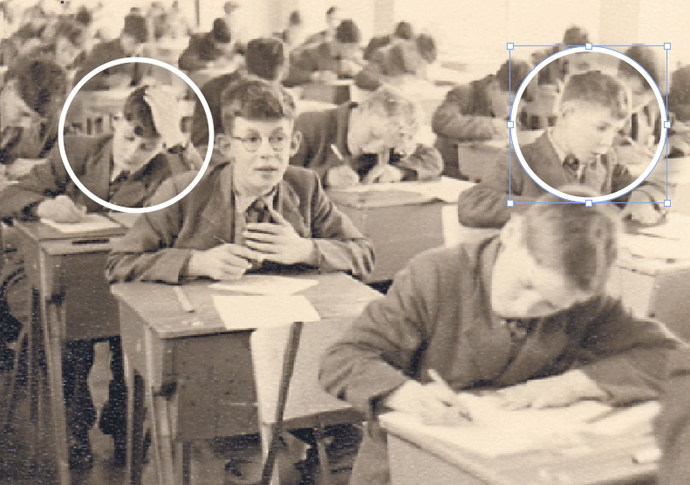
St Albans School days: Stephen Hawking (circled right) and Michael Church, hand on head [Michael Church]
THERE were six of us in our little gang, in the fast lane at St Albans School in Hertfordshire.
At weekends we might cycle to Dunstable Downs and watch the gliders if the weather was good. And if it wasn’t, we might mess about with train-sets or build model planes. Or play board games which started off as Monopoly, but for which our ring-leader devised ever more exotic variants.
In his medieval war-game, for example, it could take half an hour to work out the consequences of one throw of the dice, as laws, politics and the size of armies were put into the resulting computation. Our bemusement was his delight: the young Stephen Hawking was an archetypal lord of misrule.
He was a natural leader, with crazy charisma, and as his thoughts came out faster than he could articulate them, sometimes inventing words when the mot juste eluded him: “silhouettes” became “slit-outs”.
His ideas were wild, but they often had a serious point: for example, designing and building a vast and clunky computer, at a time when most people had no idea what a computer was.
Our school was ferociously academic, relentlessly Christian and cruelly Spartan, and everyone had to become a uniformed trainee soldier for one day each week. That included trips to the army range to learn how to fire Bren guns which were – quite literally – deafening. We all accepted the outrageous official line that “only cissies wear earplugs”, and as a result some of us were aurally scarred for life.
Stephen, on the other hand, secretly fashioned his own earplugs out of blotting paper, then couldn’t get them out, and a doctor had to be brought to remove them surgically.
This little detail doesn’t appear in Graham Farmelo’s authorised biography, but little else seems to escape his eagle eye. His magisterial book manages to present two stories, both riveting in their own right, yet simultaneously interwoven from start to finish, to a point where paradoxically they seem to have fed off each other.
Stephen’s father Frank was a medical researcher specialising in African diseases, while his mother Isobel’s passions were literary and political.
They had high ambitions for their talented firstborn Stephen, whose progress through 60 years was chronicled in an extraordinary diary written in code by his father.
Stephen’s early interest in cosmology was paralleled by the pleasure he took in the adventures of the spaceman Dan Dare in The Eagle comic; meanwhile, Wagner’s operas became a lifelong passion. He was a polymath from the start.
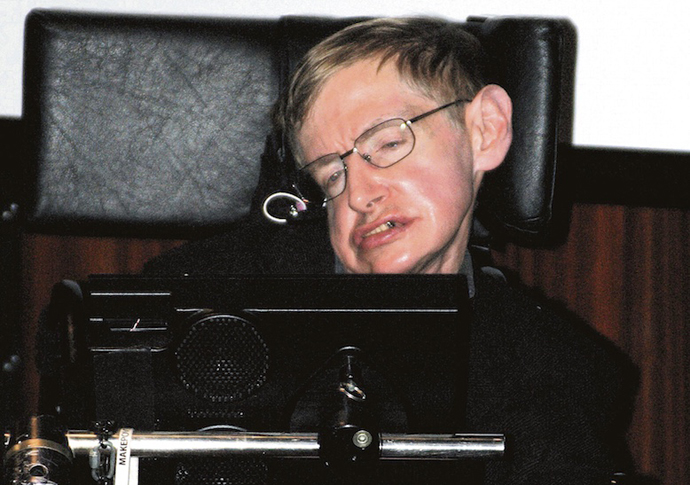
Hawking: ‘I am just a child that has never grown up
At Oxford he cut a memorably Wildean figure in a velvet jacket and bow-tie; he emerged as a rebellious funster, heroic drinker, and left-wing political radical. And he took more pleasure in coxing his college eight than he did in his studies.
He was well known to be clumsy in practical matters, but colleagues were in awe of his intellect: after three years his Oxford tutor confessed that it would have been more accurate to say that Stephen was tutoring him.
Stephen’s motor neurone disease revealed itself in inexorable stages, starting in his teens with inexplicably wonky balance and muscle weakness. The terrible truth – the current estimate was two years left to live – was announced to us by Isobel at his 21st birthday party; Stephen still insisted on pouring our drinks, much of which he splashed all over the floor.
But he never gave up, and never sought sympathy; he would deal with his problems alone. He simply absorbed the anatomical facts, and found ways to live – and above all work – with them, as his survival stretched first into years, then improbably into decades.
Gradually he lost the power of speech, but he grew to love the artificial voice he was given.
Finally he couldn’t bite or swallow, and the tubes which kept him alive multiplied. But he married his sweetheart Jane Wilde, and had three children on whom he doted.
Much of this book concerns Stephen’s arcane quest, and Farmelo does an excellent job of making it comprehensible to non-scientists. He chronicles Stephen’s endless dashes round the globe to deliver technically pellucid speeches, even when he was in excruciating physical discomfort, and often outright pain.
Much has been mischievously made of the ménage à trois which developed, with Stephen accepting the presence of a man who came in as a helper, until gossip that the third child was his, not Stephen’s, forced him to move out.
Farmelo writes sympathetically about the huge stresses Jane had to endure as her husband’s nurse and carer.
He’s equally kind regarding their eventual break-up, and also regarding the short marriage Stephen then entered into with his nurse, Elaine.
What caused the bruises to Stephen’s face? Did the excitable Elaine beat him up? No incriminating evidence was found, says Farmelo. Was Stephen guilty of hogging the limelight when discoveries were made?
Sometimes, it seems. But Farmelo makes it clear that Stephen’s work was supremely important: “He was a great elucidator of black holes: no one has done more to clarify the crucial role they play in illuminating fundamental concepts in physics.”
His own description of his goal could not have been simpler, nor bolder: “A complete understanding of the universe, why it is as it is, and why it exists at all.”
And by the end, with his books selling by the million, presidents and even the Pope queuing up to meet him, and with The Simpsons enshrining him in their show, he finally attained – and enjoyed – the fame of a rock star. “All children ask questions,” he told one interviewer. “How do things work? Why are they the way they are? I am just a child that has never grown up. Occasionally I find an answer.”
• Hawking: His Life and Work. By Graham Farmelo, John Murray, £30
