Portrait of Camden Town painter is insightful and fascinating
Frank Auerbach: Life and Death offers a gentle consideration of the artist’s life and work
Thursday, 12th November — By Dan Carrier
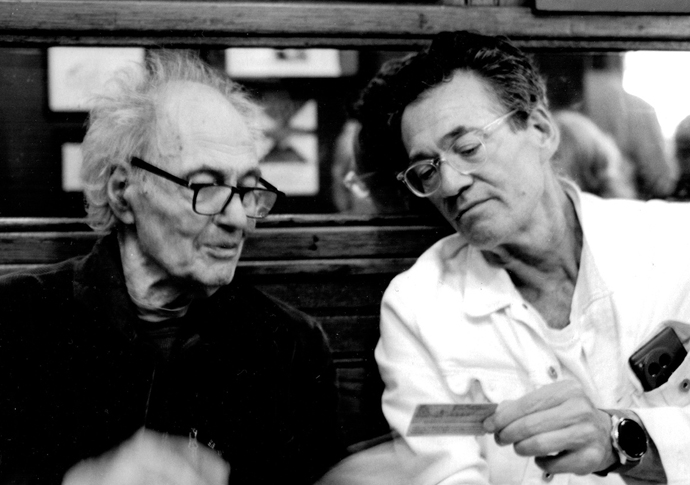
Frank, left, and Jake Auerbach
FRANK AUERBACH: LIFE AND DEATH
Directed by Jake Auerbach
Certificate: PG
☆☆☆☆
FROM street scenes in Mornington Crescent to views of Primrose Hill, Frank Auerbach, who lived in Albert Street, Camden Town, stepped out of his front door and captured beautifully the world he saw around him.
The artist died in 2024. His work is a landmark in British art, a figure who stands alongside the likes of Lucian Freud and Paula Rego, an original whose stunning works feel so recognisable: watching this documentary suggests Auerbach, more than anyone else, epitomises London art in the second half of the 20th century.
This gentle – which is a contrast to some of his portraiture – consideration of his life and work has been made by his son, Jake. It offers a unique, warm, insightful and fascinating story. Jake draws on footage shot over three different periods of Frank’s life and captures the artist deconstructing his approach. His semi-abstract, semi-realist style becomes much clearer to the untrained eye: listening to him talk about a painting on Camden High Street is a lesson in how to look.
While his father’s art, inspiration and life is obviously at this film’s heart, it is also about love: unconsciously, it is a letter from a son to a father. It feels a privilege to be given access to this relationship.
The painter’s son has turned his camera towards a subject that he cannot help be intrinsically involved in, and protective of.
While it means this film cannot fail to be coloured by the relationship between the film-maker and the subject, it also means we get a unique story told through a family prism: it’s beautiful, and a brilliant deconstruction of a key figure in British art.
Jake is a talented film-maker, too – you can see his father’s deadpan, raw-yet-complicated aesthetic approach in his son’s direction.
Jake also dismisses misunderstandings and half truths that lazy journalists have regularly trotted out and appear to be something of an annoyance.
Frank left Germany as a child – his parents were murdered at Auschwitz – but was not sent to England on the Kindertransport, as often claimed.
Jake also expresses a sense of exasperation by art critics who – again, lazily – describe his father’s art as being about layers and layers and layers of oil.
A case of setting the record straight, and paying respects to an artist whose work holds every scene.
