Rare archive reveals rich Theatre Royal records
Albums detail early life at Haymarket venue that opened in 1720
Friday, 23rd October — By Dan Carrier
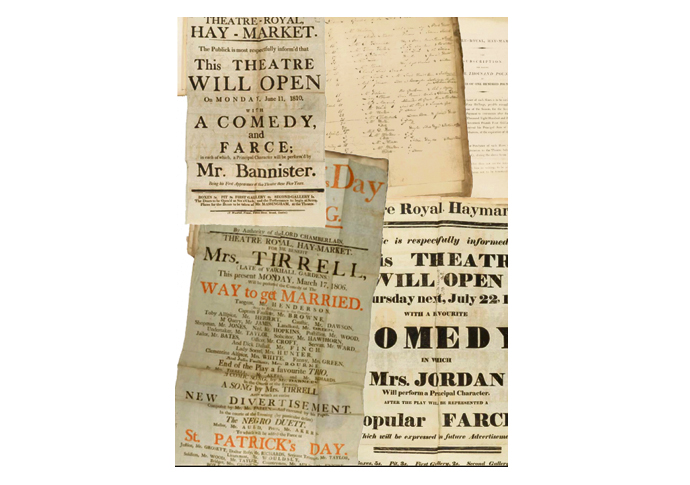
From 1810: ‘The Publick is most respectfully inform’d that…’ the theatre will open with a comedy and a farce
A UNIQUE archive that brings to life the past times of a world famous West End theatre has been discovered, and is now up for auction.
Two albums packed with press cuttings, programmes, reviews, playbills and notices – put together by theatre workers – reveal life at the Theatre Royal, Haymarket. The theatre was opened in 1720 and given a royal patent in 1766.
Antiquarian booksellers Jarndyce, based in Bloomsbury, have put the albums up for sale with a guide price of £7,500. They are described by Jarndyce staff as “a remarkable survival” revealing the daily life of a theatre 200 years ago.
The sales brochure states: “Chronologically arranged, the volumes form an almost daily record of activity at the theatre, which was one of the best-known and well-frequented of London’s many theatres at the time.
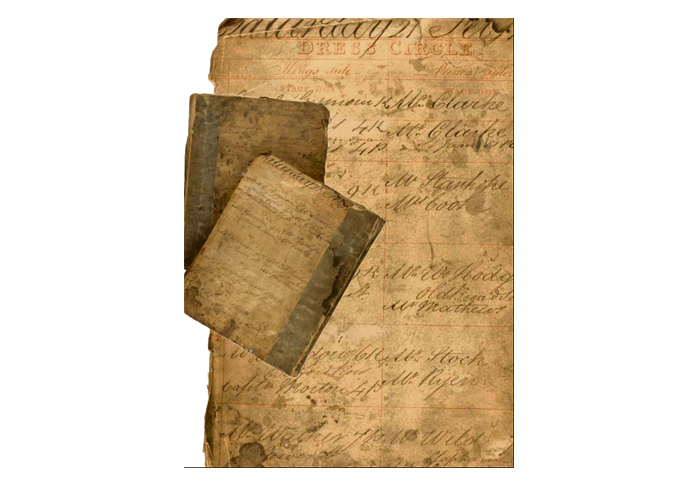
Dress circle records
“It appears that any printed matter that related to the theatre was pasted in, from two-line notices of forthcoming productions to extended reviews, as well as official playbills and announcements issued by the theatre itself.
“Although the publications are seldom identified, each notice, however brief, is neatly dated in a contemporary hand, the earliest dating from late January 1805, and the last to autumn 1823. The number of notices runs to many hundreds, neatly pasted in two columns on each page.”
And the lot – due to be sold at the Boston Book Fair in the USA in November – includes 62 play bills folded and pasted on one page, and there are tantalising pieces of evidence to the business of running a Georgian theatre.
Jarndyce’s brochure adds: “At the beginning of the earlier volume are several documents that relate to the financing of the theatre, including a printed ‘subscription for raising three thousand pounds, by thirty shares of one hundred pounds each’. Also pasted in, a single page manuscript notice outlining ‘Licences Granted by the Lord Chamberlain’ for various productions in late 1804 and the first part of 1805.”
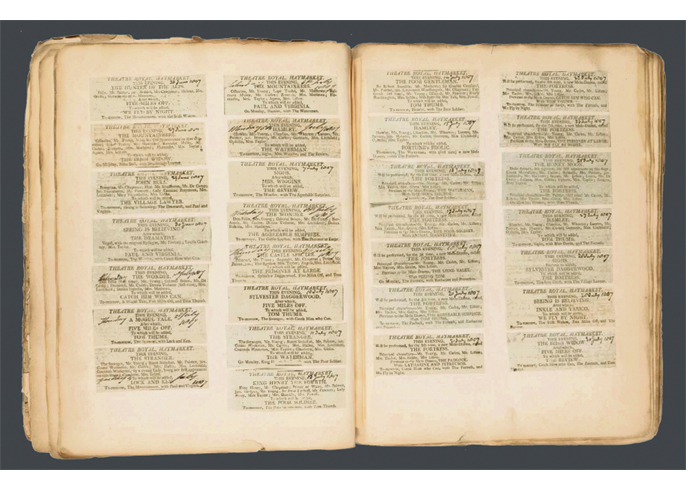
Ticketing history, and more, with annotations
And we get an idea of the theatre going publics tastes: as well as plays by Shakespeare, Sheridan and Colman, the theatre hosted shows that were not dramatic works – including “Largest and most magnificent orrery”, a mechanical model of the solar system, and “Mr. Lloyd’s Astronomical Lecture”.
And the behaviour of audiences is also noted through newspaper cuttings.
We learn via cuttings of a violent “fracas” that disrupted one show and led to an arrest and a court case.
The Colman family ran the theatre from 1777 first headed by George Colman, and then by his son, George Colman Junior.
George Junior was a celebrated playwright but lacked the business nous of his father, and ran up large debts.
By the time of the albums, George Junior – who was later sent to a debtor’s prison – had been forced to find partners to keep the lights on.
The brochure adds: “These volumes offer remarkable insight into the fluctuating fortunes of the theatre, and the succession of shows it was able to produce. This was a period during which the Haymarket experienced immense upheaval – not least its relocation into new premises in 1820 – all of which is diligently referenced throughout this rich archive, undoubtedly compiled contemporaneously by a figure (or figures) embedded in the running of the theatre.”
